
The Monkey, the Mango, and the Mademoiselle
A Brief History of the IIT Joint Entrance Examination

In the beginning, God created the Earth, and shortly thereafter, He created the Indian Institutes of Technology (IIT). He did this so Indian parents would have a legitimate reason to stop speaking to their children for at least four years.
I’ve been looking into the IIT Joint Entrance Examination (IIT-JEE) lately, and I’ve discovered that it has changed slightly since I wrote it in 1985. By “slightly,” I mean in the same way that a light jog through Nageswara park in Mylapore has changed into being chased by a pack of caffeinated dire wolves through the jungle while trying to solve a Rubik’s Cube with one hand tied behind your back.
My own journey toward the “Temple of Technology” began in the summer of 1983 at, of all places, the Alliance Française in Chennai. I was enrolled in a French class, a setting that, in any normal universe, should have been the backdrop for a classic romcom.
The class was a vibrant tableau of 1980s Chennai youth. Notably, it was full of pretty damsels. They wore short skirts, smelled of expensive talcum powder, and possessed the kind of effortless charm that could make a young man forget his own middle name. Any sane chap would have seized the opportunity to perfect his French accent to impress the girl in the third row.
But I was not a sane person. I was on a mission, and that mission was named “Venkatachallam.”
Venky was an actual, living IIT student. He was in my French class. In the social hierarchy of 1983 Chennai, an IITian was somewhere between a major God from the Hindu Trinity and the guy who knew the secret recipe for Ambika Appalam Depot’s sambar podi.
I followed Venky around like a confused puppy. I wanted to learn French but I mostly wanted to be like Venky. I figured if I could get into IIT, I too would possess that superhuman glow he exuded. I spent my afternoons absorbing his wisdom, and ignoring the pretty damsels in short skirts in our French class who were definitely wondering why I was obsessed with a guy who spent his weekends calculating the friction coefficient of his own sandals.
Today, I deeply regret this. While Venky was explaining the beauty of an Irodov physics book, those damsels spoke the language of love. Instead, I chose the “Language of the Pulley,” and I don’t think the universe has ever forgiven me for it. I’ve also realized that Venky didn’t have his priorities straight either. He too spent his time on a rando kid instead of pretty girls. That should have been a major red flag right there, in hindsight.
Once the Venky-induced fever took hold of my brain, I realized I had a problem the size of a portly, middle-aged TamBrahm professor from Vivekananda College named Sankaran.
Sankaran ran an IIT coaching center. He was a man of strict, almost aristocratic academic principles. When I asked if I could join his coaching class, he didn’t ask about my dreams for the future. Instead, he looked at my records and saw the mark of the beast: “State Board.”
Back then, there was a Great Schism in Indian education. On one side was the CBSE (Central Board of Secondary Education), an elite breeding ground for future rocket scientists. On the other side was the Tamil Nadu State Board, which Sankaran essentially viewed as a place where people went to learn how to count using their toes.
Sankaran bluntly refused to admit me. To him, coaching a State Board student for the IIT-JEE was like teaching a goldfish to play the electric guitar - a waste of time and frankly insulting to the guitar. I was cast out into the wilderness.
Rejected by the guru and having ignored every pretty girl in a short skirt in Chennai, I was left to my own devices and only one other option: “Agarwal Classes.”
Agarwal Classes was a “correspondence course,” a fancy way of saying - if you sent money to Bombay, the postman would deliver a stack of thin, yellowish booklets that looked like they had been printed on a machine from the Victorian era. These booklets were the holy grail. While my friends were out at the movies or the beach, I sat in a room with a tubelight and a single oscillating fan, ignoring pretty girls in short skirts, obsessing over “Problem Set 4,” trying to figure out why a sphere was rolling up a hill without slipping.
My “test prep” as a State Board rebel consisted of:
The Agarwal Booklets: Smelling faintly of ink and Sangam era dust.
One (1) HB pencil sharpened with a razor blade until it could be used for minor surgery.
A profound sense of spite, fueled by the thought that I wasn’t “CBSE enough” for Sankaran
To understand the gap between what it took to get into IIT in 1985 and now, we must now turn to a classic physics problem. Back then, neither the Agarwal guys nor the IIT professors who set the JEE questions cared about “tricks.” They only wanted to know if you could survive a physical encounter with a primate.
The Setup: A massless, inextensible rope passes over a frictionless pulley. On one end hangs a 10kg crate of mangos. On the other end, at exactly the same height, hangs a 10kg monkey named Newton.
Note: Of all these things mentioned above, the only thing that exists in the real world is a crate of mangos, and I’m not sure of even that.
The Inciting Incident: Suddenly, the monkey randomly begins to climb the rope with a constant acceleration of “a” relative to the rope.
The Question: What happens to the mangos?
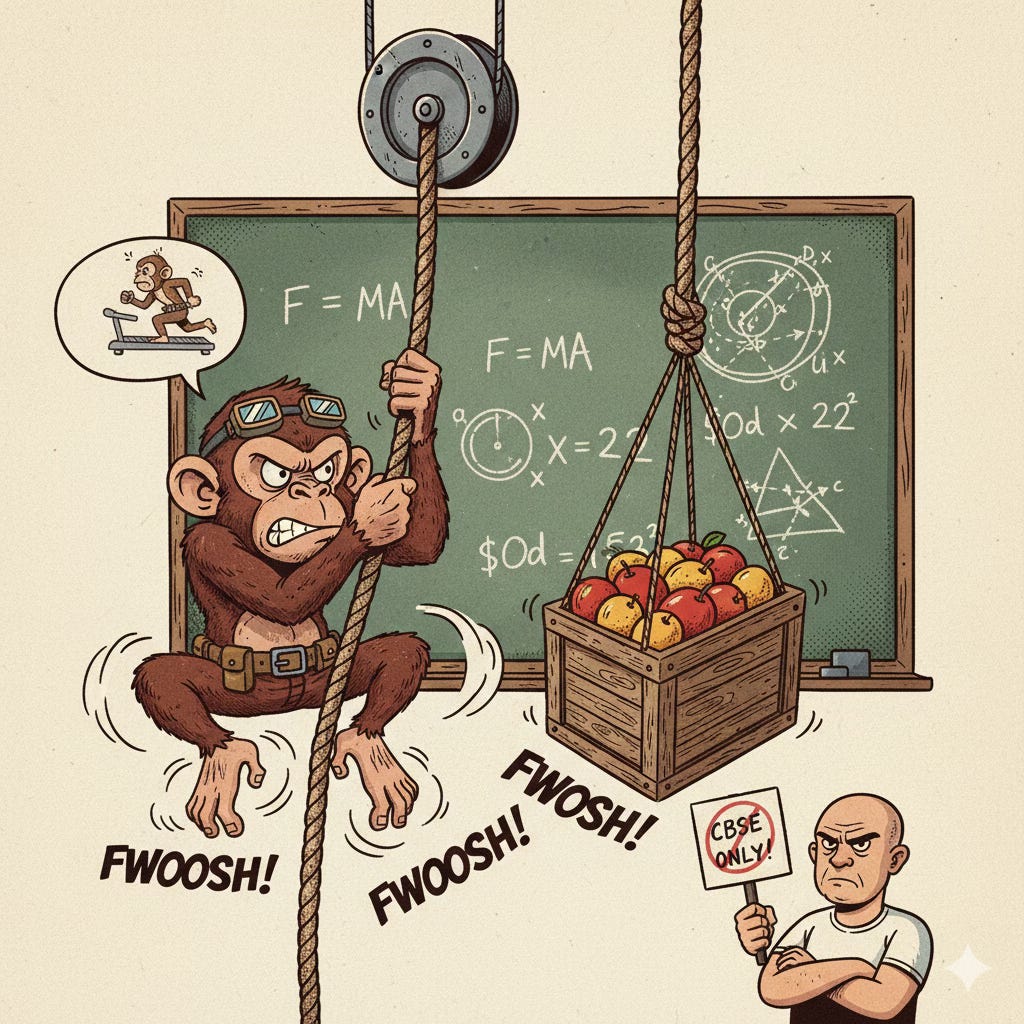
In 1985, armed only with Agarwal notes, the 1985 student, let’s call him Cash, would use Newton’s Second Law (F=ma). Since the rope is one continuous piece, the Tension (T) is the same on both sides. When the monkey pulls down to move up, he increases the tension. This tension pulls the mangos up.
The Solution: The mangos move upward at the exact same rate as the monkey. They are eternally linked in a vertical dance of frustration. The monkey thinks the mangos will lower to the ground as he climbs. Alas he never reaches the Banganapallis by climbing. He is essentially like a white collar worker on a vertical corporate treadmill.
It was a perfect metaphor for my life. In 1985, I was the monkey, climbing frantically toward the “IIT Dream,” and the “mangos” (a normal social life, going to the movies with pretty girls in short skirts) were eluding me at the exact same speed.
Fast Forward to 2026.
The world has changed. If Cash’s 1985 method was “Lone Wolf Cowboy Physics,” the 2026 method is “The Industrial Complex.” The postman has been replaced by a 5G connection and Agarwal’s yellow booklets by “Learning Modules” on an iPad. Getting into IIT today begins approximately three weeks after conception. By the time a child is 3 years old, she is sent to Kota, a city that consists entirely of 3-year-olds who have never seen sunlight.
The modern JEE exam is two parts, and the first part is “Objective,” meaning a high-speed multiple-choice marathon. Today’s student - let’s call him Abhinav - doesn’t solve the monkey problem. He doesn’t wonder about the tension in the rope. He has no tension in his shoulders either. He identifies symmetry (both the monkey and the mangos weigh the same). Then he applies a “Super-Fast Trick,” popularized by “Vikas sir” on YouTube. Next he looks the options:
(A) Mangos stay still.
(B) Mangos go down.
(C) Mangos go up.
(D) The monkey becomes a Senior Product Manager at Meta.
Abhinav picks (C) within three seconds and spends the next 57 seconds of the allotted time scrolling Insta reels. Abhinav has the right answer, but has no idea why the monkey is sad.
In 1985, the IITs wanted to see if you could think. They wanted to know if you understood that the universe is a weird place held together by tension and logic. Today, the IITs want to see if you can survive. It’s no longer about whether you can build a bridge. It’s about whether you can stay awake for 72 hours while staring at a diagram of a frictionless wedge.
Today, Cash understands the universe, has met a few damsels since, but is wondering why Sankaran was such a jerk. Abhinav is a billionaire at a tech startup, but has never ever seen monkeys, mangos, pulleys or damsels. Also, I think the State Board kids are just fine. If you can figure out a pulley without Sankaran’s help, you can figure out anything.
I think we should go back to the old ways of solving physics problems. But then again, I also want to go back to the times where phones were attached to walls and no one could call you while you were in the bathroom.
But, if I could, if I just could… go back to 1983, I’d tap that pretty damsel on the shoulder and say, “Excusez-moi, mademoiselle. I am currently ignoring a very smart guy named Venkatachallam to talk to you. Voulez vous prendre some Aavin flavored milk in Adyar and discuss how we are both currently bound by the laws of gravity, but only one of us cares?”
But I didn’t. I stayed a State Board rebel, and solved the Agarwal booklets. And then I grew up only to realize that while physics is constant, youth is a variable that decreases over time.
Have an amazing week ahead!
Thus goes IIT saga.