
How I Accidentally Found America’s Best Decade
The Long Whiplash of the American Dream

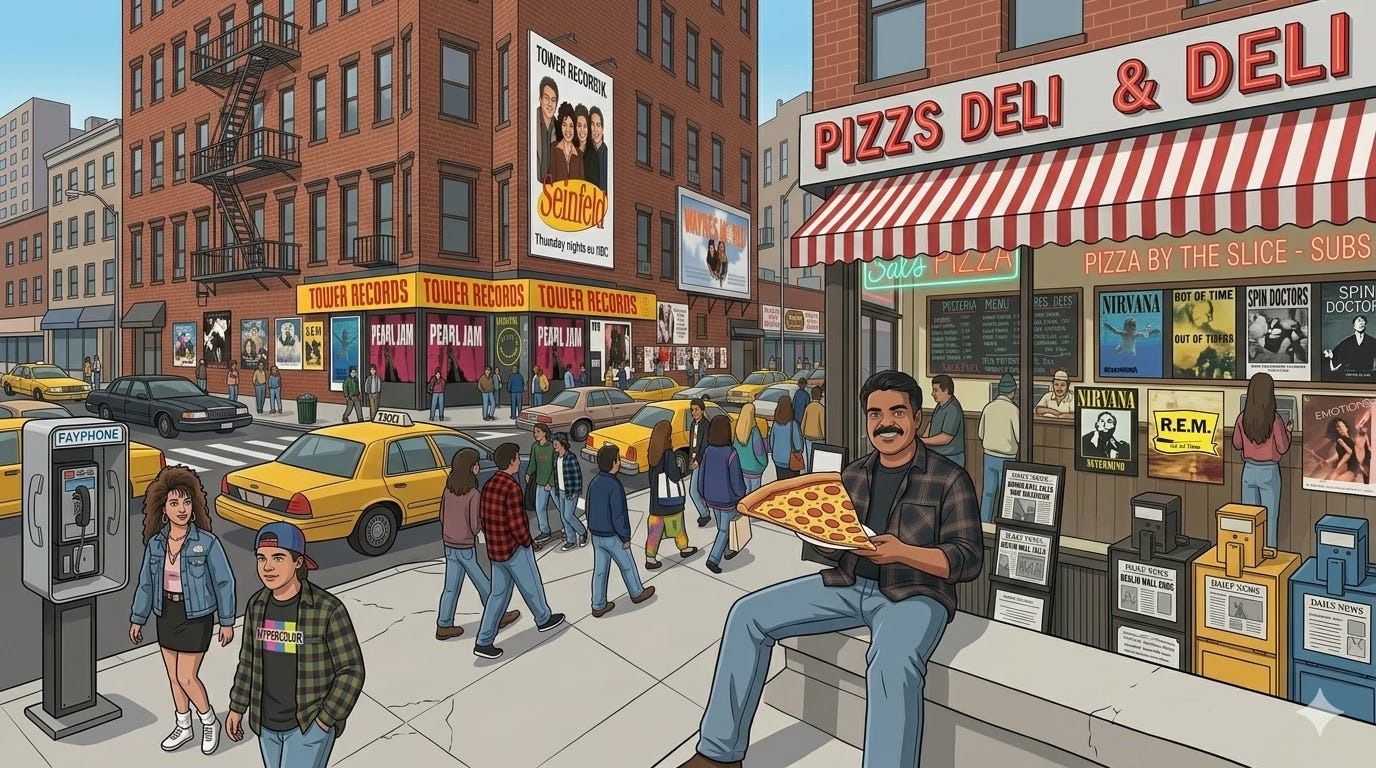
I landed in America in 1989, a student with a single suitcase and the incredible, blind luck of a forest fire survivor who accidentally stumbles into a garden party. I didn’t know it then, but I had arrived at the absolute “high-water mark” of American Civilization. The Berlin Wall was coming down, the “End of History” was being declared by academics in turtlenecks that were clearly too tight for their brains, and the air smelled like expansion and the citrusy, gender-neutral optimism of Calvin Klein One.
On my first afternoon, I ambled out to seek out that legendary American staple: the pizza slice. I walked into a corner shop and was handed a triangular slab of dough and cheese so enormous that it didn’t just have a “topping” - it had its own zip code. I sat on the curb, staring at this grease-spotted marvel, roughly the size of a standard boogie board, and realized I had landed in a place where there was clearly plenty for all to go around. Where I came from, food was served with a certain “we might run out of atoms tomorrow” caution in eating establishments. Here, a “single slice” was a structural engineering project. The scale of the food was a proxy for the scale of the optimism.
The early 90s had a specific, almost defiant “lightness” to them. Back then America was a country that could laugh at itself without first having to clear it with a seventeen-member Committee for Not Offending Anyone Anywhere Ever. When Dana Carvey spent years on SNL relentlessly parodying George H.W. Bush - turning the leader of the free world into a twitchy man who lived in constant fear of things not being “prudent” - the President didn’t launch a ten-part Truth Social thread at 3AM about “failing comedy.” He invited Carvey to the White House. They stood side-by-side, laughing at the same joke. We had a sense of humor back then, which is actually a medical term for “not being a total ass.”
And the lights began to go out.
It turns out that 9/11 wasn’t just a tragedy; it was the moment America decided to have a permanent, national nervous breakdown. We traded our lightness for a state of “High Alert” that basically meant we all had to act like we were in a low-budget spy thriller. We traded our spontaneity for the theater of the TSA, a ritual where we all stand in our socks looking like we’re waiting for a very depressing communal shower, all to prove that our Dr. Scholl’s inserts aren’t weapons of mass destruction.
And don’t get me started on the “fear of speaking up.” We used to mock the Soviet Union for that. Now? Between the “Pretenders” on the Left and the “Evangelists of Chaos” on the Right, saying the wrong thing at a dinner party is treated like a war crime.
While we were busy looking for terrorists in our shampoo bottles, the ground was being cut from under our feet at home. The NAFTA deal - signed by Bill Clinton with that “I’m the smartest guy in the room” smirk - effectively told the American Midwest: “Hey, thanks for the memories, but we’ve found some people in other time zones who will work for the price of a chicken sandwich.” Whole towns were hollowed out. Church attendance had already been dropping off a cliff, and in the vacuum where “community” used to live, a “forgotten generation” moved in. These guys didn’t lose their jobs to “progress”; they lost them to a spreadsheet. And when they realized the “American Dream” was now a subscription service they couldn’t afford, they turned to opioids. It was a slow-motion 9/11 that didn’t get a monument. It just got a a lot of obituaries.
The trauma was so great we started whiplashing like a crash-test dummy. George W. Bush invaded Iraq for “reasons” that turned out to be as real as Bigfoot. Then Wall Street decided to play Russian Roulette with the global economy, nearly burned the house down in 2008, and then had the gall to ask us for a cigarette and a match. We went from a mindset of abundance to one of zero-sum games. You know, the game where my neighbor’s success feels like he’s reached into my pocket and stolen my wallet.
In hindsight, the arrival of Donald Trump was about as surprising as a jump-scare in a bad horror movie. He wasn’t a glitch in the Matrix. He was the inevitable result of a country that had stopped taking its meds. On one side, you had the people “Pretending” - you know, the ones hunkered down in false security, re-arranging the deck chairs while the Titanic is almost vertical, convinced that “it can’t happen here” and arguing that “my bad guy is better than your bad guy.” On the other side, you had the people with an almost evangelical zeal to make, precisely, absolute nadir happen - the “Burn It All Down” crowd who wanted to see the elites cry by letting the “my bad guys take over,” even if it meant setting their own living room on fire.
We are all severely traumatized.
Here’s the thing: Traumatized people lose sight of reality. They lose the ability to course correct. They’d rather conduct a Viking funeral for the bad guys.
So, where does that leave us? How do we heal a country that has forgotten how to breathe?
Last year, my wife and I were in Granada, in Spain, waiting for a train. I stepped out of the station for a smoke and saw a guy in his 30s - a blue-collar worker - sobbing into his phone. My Spanish (courtesy of a Duolingo owl that I am fairly certain is a high-ranking member of an international hit squad) was just good enough to understand: he was leaving home for work, and he was heartbroken to be leaving his wife and his three-month-old baby behind.
He hung up, and stood there forlorn, looking like he’d just lost the whole world. And right then, I felt this inexplicable urge. Now, normally, “inexplicable urges” involve things like wanting to buy a $500 zoom lens for a DSLR camera you last used four years ago. But this was different. I walked over and gave him a big hug. I just held him for a second and said, “Tranquilo... todo estará bien.” (Calm down… everything will be okay). He didn’t pull away. He just hugged me back. In that moment, we weren’t two strangers; we were just two dads, standing on the side of the road, trying not to let the weight of the universe crush us into incoherent, weeping puddles.
That is the “inexplicable urge” I think we need. We have to go back to being dads and moms and neighbors first - even if it means doing things that would make “our team” upset at us. They might even kick us off the team. But the point is - healing won’t come from “being on a team.” It won’t come from a policy or a white paper or the next election when we swear we will win it all back again. It really starts when we stop warring and start being human again. We must acknowledge each other’s grief, even if we’re pretty sure the other guy has terrible taste in bumper stickers. If I see his grief, maybe … maybe someday he too will see mine.
To heal ourselves, we have to be willing to step out of our bunkers, brave the bullets, and give the “inexplicable hug” to a country that is, quite frankly, crying its eyes out. We caught the high-water mark once. We saw what “plenty” looked like in a pizza slice that required a zoning permit. If we can find the courage to acknowledge one another again, we can move on - maybe not to greatness, but to mere normalcy, a luxury these days. Maybe, once we finally stop trying to drown each other, we can just learn how to float. And then, maybe, just maybe, we can find a slice of pizza big enough for everyone to share.
—
Now it’s your turn. I want to hear your “giant pizza slice and massive Coke bottles” stories. Maybe it’s a memory of a kinder America that comes to your mind, or maybe you just once saw a squirrel do something genuinely impressive. Whatever it is, please share - about this country or just life in general - as long as you write back! I’ll be right here, hiding from that homicidal Duolingo owl and waiting for your responses.
Have a great weekend!
Good. Enjoyed reading .
Nice Pic. The Pizza has to be from 'Flying Tomato' on High Street!!